
In 2025, we published our Portrait of West Island Tenants, a report that documented the experiences of the West Island tenants, and the difficulties they might be facing with their living conditions. This report showed that there remain some significant gaps in housing policy in the West Island, most notably with affordability and sanitary conditions.
Considering the gravity of the housing crisis in the West Island, we believe this is an opportune and crucial time to make systemic changes to housing in the West Island. It is clear that there is not enough social or not-for-profit housing and that rents have been skyrocketing since 2020. For too long, the struggles of low-income and working class renters in the West Island have been ignored. The attitude of many of the local leaders in the West Island has been that “everything is fine here”, “we don’t have a housing crisis.” Whether it be growing inequality, rights violations, unjustified evictions, unsanitary living conditions, or discrimination, it is the most vulnerable among us who bear the greatest burden of this crisis, and for a region as wealthy as the West Island, it is imperative that this issue be addressed with the seriousness, rigour, and urgency it requires.
In partnership with the Table de quartier Sud de l’Ouest-de-l’Île (TQSOI) and the Table de quartier du Nord de l’Ouest-de-l’Île (TQNOIM), the present document is a set of actions for each West Island municipal election candidate to read, absorb, and to adopt into their platforms in anticipation of the upcoming November 2025 election, and to consider when elected. We are aware that housing is a shared responsibility between the federal, provincial and municipal governments. As such, we have developed a policy platform, which advocates for a series of concrete actions that our municipalities can take to address the housing crisis and ensure the dignity and well-being of all West Island residents.
This is a call to action.
We call on the cities and boroughs of the West Island to:
- Officially recognize the housing crisis
- Create open lines of communication between themselves and West Island community organizations working in housing
- Support the development of a diverse range of housing options, including emergency, transitional, and not-for-profit housing.
- Agree to and implement emergency housing agreements with the Société d’habitation du Québec and the Office Municipal d’Habitation de Montréal
- Adopt a sanitation and maintenance by-law and enforce this by-law in a transparent, consistent, and courageous manner.
- Collaboration and mutualization of resources between municipalities on housing projects, explore ways to pool resources, and, together, come up with new strategies to develop not-for-profit housing projects.
- Engage in joint housing advocacy for the West Island, whether lobbying to the Communauté Métropolitaine de Montréal, the provincial government, or the federal government.
- Ban short-term rentals, such as AirBnB.
- Actively combat NIMBYism in their communities, particularly when facing opposition to not-for-profit housing projects.
- Create and foster an environment to encourage and actively support the development of not-for-profit housing.
Taking Action for Housing:
Community Advocacy for Housing in the West Island
Find your local candidates:
https://www.electionsquebec.qc.ca/en/vote/candidates
West Island Political Events:
The CALODI team has created a public calendar to share West Island’s election candidates events, allowing our members to go out and meet their prospective elected officials. Please share any local political events with the CALODI team we’ll be happy to post it on the calendar. We hope that this will be a useful tool and that our members will promote the CALODI’s Action Points, listed above.
You’ll find the Calendar here: https://teamup.com/kswf2bv2yufjnxnk17
Did you know that tenants in Quebec can refuse an unfair rent increase?
Every year, the Tribunal administratif du logement (TAL) releases percentages for the fixing of rent that landlords must use to calculate a legal rent increase. Unfortunately, many landlords ignore these percentages and propose rent increases that exceed the legal limit. Often, landlords will target tenants who are paying rent that is below “market value,” or they try to use rent increases as a way to pay off their own mortgages. But, in Quebec, the “market value” of your apartment or the cost of your landlord’s mortgage has no legal bearing on what your rent increase should be!
You have a right to refuse an illegal rent increase AND stay in your apartment. And you MUST refuse an illegal rent increase when it is proposed to you. Otherwise, it is not possible to go back and contest an illegal rent increase once you have accepted it.
As a part of our campaign on “Refusing an illegal rent increase,” the CALODI has developed an informational guide for tenants and a toolbox for estimating a fair rent increase. We also host a series of workshops every year between January and March – when most tenants in Quebec receive their rent increases – to teach tenants about their rights, how to properly refuse a rent increase, and what happens after you refuse a rent increase. Stay tuned for our 2025 series of workshops, which will be announced in December 2024.
The CALODI also recognizes that the measures currently in place to curb rent increases are not sufficient to protect tenants, particularly in the current housing crisis. The reality is that rents are increasing at unprecedented rates that far exceed the TAL’s legal limits. According to the RCLALQ’s latest annual survey on rental housing prices, published in June 2023, the average rent for a 4 ½ for rent in Quebec increased from $1,222 per month in 2020 to $1,504 in 2023. Why is this happening?
Although there are limits to how much a landlord can legally increase rent, it is up to tenants to enforce these limits, and too many landlords get away with exorbitant rent increases each year. Many tenants are simply unaware that they have the right to refuse a rent increase, and many landlords use pressure and threats to force tenants to accept excessive rent increases. Furthermore, the TAL’s percentages regarding the fixing of rent take into account a landlord’s expenses but not a tenant’s expenses, which are on the rise each year. More and more tenants in Quebec are having trouble keeping up with even the legally permissible rent increases. Something has to change, now, which is why the CALODI advocates for a provincial rent freeze and a mandatory rent registry.
Click here to learn more about the RCLALQ’s rent control campaign and to send a letter to the Minister of Housing, France-Élaine Duranceau.
Did you know that tenants in the demerged cities of the West Island do not have access to the same emergency housing resources as residents of the city of Montreal?
West Island households from demerged cities that find themselves homeless after a repossession or “reno-viction” are not covered by the emergency accommodation service of the OMHM’s referral service, which is funded by the City of Montreal. Residents of the City of Montreal are eligible for temporary housing, reimbursement of moving and storage costs, and housing search assistance through the referral service. However, residents of demerged cities are not eligible for the same benefits, and there are no equivalent services in these cities. Considering that only 20% of housing units in the West Island are rentals and that the West Island is home to a mere 4% of the island’s social housing, it is not easy for tenants to find adequate and affordable housing once they are displaced.
On November 8, 2023, we sent a letter to the demerged cities of the West Island, signed by 91 West Island residents and community organizations, urging them to fill in these gaps in emergency housing resources and suggesting that the following measures be taken:
1. Apply for a subsidy under Stream 1 of the Programme d’hébergement temporaire et d’aide à la recherche de logement (PHTARL) of the Société d’habitation du Québec (SHQ), which allows municipalities to support households facing homelessness and victims of fires and other disasters. In accordance with a budgetary framework and agreement with the SHQ, municipalities can pay for moving and storage costs of admissible households, provide no-cost temporary housing for up to two months, and be reimbursed by the SHQ. The SHQ will reimburse 50% of a municipality’s eligible expenses, up to $0.80 per resident of the municipality; for reference, the maximum contribution from the SHQ according to this framework would represent approximately $15,000 in Dorval, $25,000 in Pointe-Claire, and $39,000 in DDO. This is a significant amount of funds that the cities of the West Island should be making available in order to be able to support their most vulnerable citizens through difficult times.
2. Under Stream 2 of this program, it is also possible for cities to contact the Office municipal d’habitation de Montréal (OMHM) to begin discussions on possible service linkages with the referral service, in order to allow low-income residents of demerged cities to have full access to the housing search assistance service all year round. Although demerged West Island cities are within the territory of the OMHM, residents of these cities are not included within the mandate of the referral service if they are made homeless by a repossession, “reno-viction,” or sanitation evacuation. The referral service is a robust service, providing assistance to over 5,000 households per year. The reality is that demerged cities in the West Island have already relied on and benefitted from this service many times. In 2023, 12 households from demerged cities in the West Island were accompanied by the OMHM’s referral service. If demerged cities are not able to come up with an equivalent service for their own citizens, it is important that yearly service and funding agreements with the OMHM be made so that when citizens are in need, they will be able to receive support without long delays and uncertainty. The case-by-case approach that has been used thus far creates confusion and adds to the already tremendous stress faced by tenants at risk of imminent homelessness.
We will continue to advocate on behalf of these policies and work with cities to ensure that all tenants in the West Island have equal access to emergency housing resources. If you are a tenant in a demerged city of the West Island, we encourage you to reach out to your local elected officials and express your support for this campaign.
Are you having problems in your building? Fed up with inaction by your landlord and long wait times at the TAL?
More and more tenants in Quebec, and in the West Island specifically, are coming together with their neighbors to form tenants’ unions and tenants’ associations. In the last year alone, 4 new tenants associations and unions have been created in Pointe-Claire, and many tenants have seen significant improvements to their living conditions since joining a union. Montreal’s Autonomous Tenants’ Union (SLAM-MATU) has also been making waves since its founding in 2021, encouraging and supporting tenants who are hoping to unionize their neighbors to combat abuses and push for change.
Forming a tenants’ union or tenants’ association is a great way to build power and cultivate community with your neighbors. There is an inherent power imbalance in the relationship between landlord and tenant. Tenants have rights but they do not always have the time or financial and legal resources to go against their landlord and enforce these rights. Additionally, waiting times for a hearing at the TAL can exceed 12 months, and there is a well-documented bias against tenants at the TAL.
Talking to your neighbors about your shared experiences, building on each others’ strengths, and supporting each other through difficulties is an excellent way to build collective power and strengthen your sense of community. When dealing with a difficult landlord, find strength in numbers!
It is completely legal in Quebec to form a tenants’ union or association, and tenants’ rights to freedom of association and freedom of peaceful assembly are protected under the Charter of human rights and freedoms. There is no set way to form or organize your union or association, and getting started is as simple as talking to your neighbors!
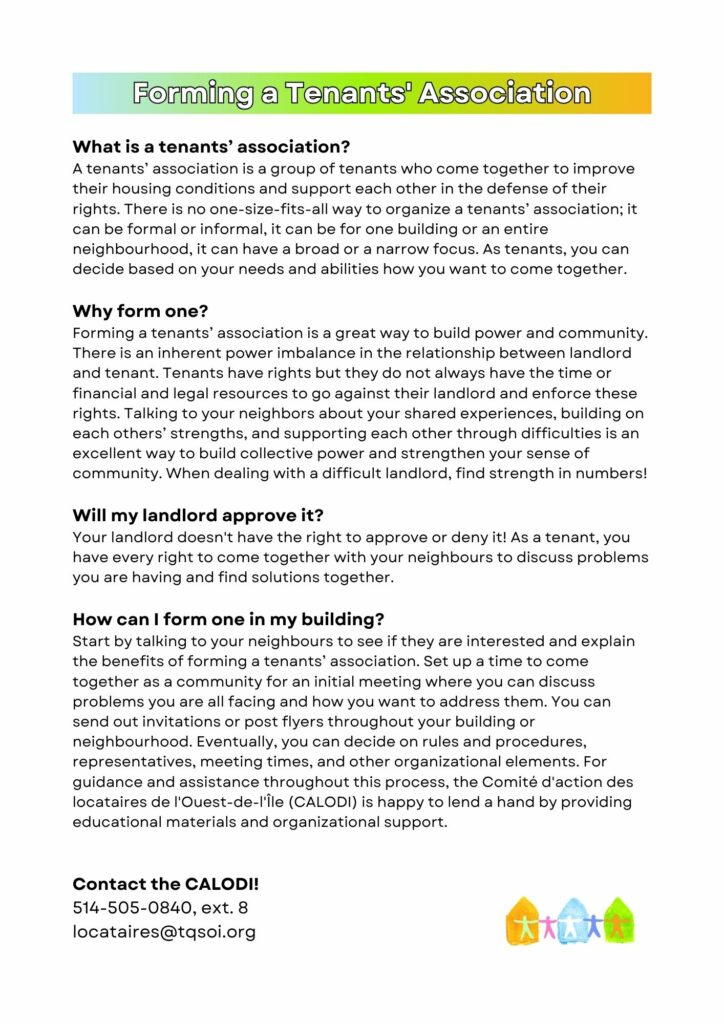
The CALODI can provide support, including educational materials and resources, training, and coordination to tenants who are interested in forming a tenants’ association. Click the image to the right to download our flier on “Forming a Tenants’ Association.”
Click here to learn more about Montreal’s Autonomous Tenants’ Union.
Did you know that the most drastic rent increases occur between two tenants?
Although landlords are not permitted to increase the rent drastically between two tenants and must always respect the TAL’s guidelines regarding the fixing of rent, the reality is that landlords often get away with excessive rent increases when signing on a new tenant. Technically, a landlord is supposed to declare, in section G of the lease, the lowest rent paid in the last 12 months by the previous tenant when signing a lease with a new tenant. However, many landlords leave this section blank or make a false declaration, making it hard for new tenants to combat these kinds of abusive rent increases.
Since we do not yet have a mandatory rent registry in Quebec, the next best way to combat these rent increases is to share information with each other as tenants. So, when you move out of an apartment, pass along a copy of your lease or your most recent lease renewal to the new tenant, either by handing it to them on moving day or mailing a copy to them after you move out. This allows the new tenant to apply to the TAL to have their rent lowered, if Section G was left blank or if the landlord made a false declaration in the lease.
If you sign a lease and section G is completed, and you can see that your rent has been substantially increased from the previous tenant, you still have 10 days from the date of signing the lease to apply to the TAL to have your rent lowered. You can contact the CALODI for help applying to the TAL.
Click here to read more about the RCLALQ’s “Pass me your lease” campaign and to download their flier, which you can give to your neighbors to encourage them to pass on their lease when they move. As tenants, we are stronger when we work together!